Virtual Mobility
Towards harmonised neonatal EEG preprocessing across clinical settings
Jovana Kljajic’s EEG101 Virtual Mobility brought researchers in Novi Sad and Cork together to compare neonatal EEG acquisition and preprocessing practices and develop an initial harmonised framework for heterogeneous clinical settings.
- When
- May–August 2026
- Where
- Online collaboration between Novi Sad, Serbia and Cork, Ireland
- Host
- INFANT Research Centre/CergenX, University College Cork
- Working Groups
- WG1, WG2
Why this mattered
Making neonatal EEG comparisons more robust
Neonatal EEG is collected in diverse clinical environments, using different acquisition systems, channel configurations, sampling frequencies, filtering practices, and approaches to signal-quality assessment. This Virtual Mobility examined how those differences shape preprocessing decisions and downstream comparisons, particularly where machine-learning approaches and cross-dataset analysis are envisaged.
What the collaboration did
From clinical observation to a shared framework
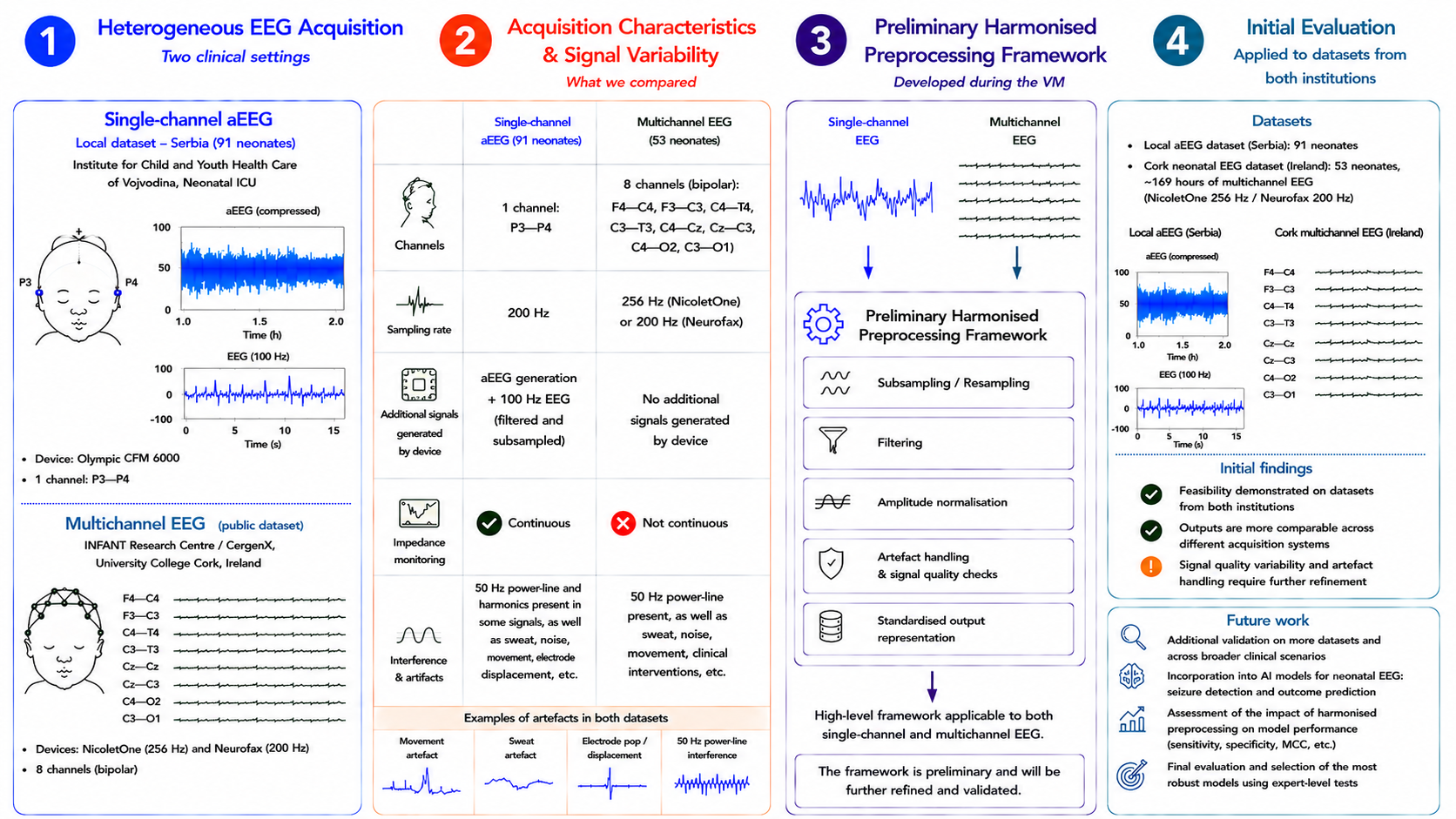
Regular online meetings brought together Jovana Kljajic and Prof. Tamara Škorić at the University of Novi Sad with Dr. John O’Toole and Dr. Robert Hogan at the INFANT Research Centre/CergenX, University College Cork. In parallel, clinical visits to the Neonatal Intensive Care Unit at the Institute for Child and Youth Health Care of Vojvodina informed the work with direct insight into artefacts encountered during routine aEEG monitoring.
Key outcomes
- A comparative review of neonatal EEG acquisition hardware, channel configurations, sampling frequencies, filtering, and signal-quality assessment across participating settings
- An initial harmonised preprocessing framework applicable to both single-channel and multichannel neonatal EEG recordings
- Initial testing across a local aEEG dataset and the open-access Cork neonatal EEG dataset
- Identification of clinically relevant artefacts, including movement, electrode displacement, and interference from clinical equipment
- Methodological input to EEG101 Deliverables D1.1, D1.2, D2.1, and D2.2
People and places
Harmonised preprocessing workflow
People and places
A continuing neonatal EEG collaboration
- Jovana Kljajic, Faculty of Technical Sciences, University of Novi Sad
- Prof. Tamara Škorić, Faculty of Technical Sciences, University of Novi Sad
- Dr. John O’Toole, INFANT Research Centre/CergenX, University College Cork
- Dr. Robert Hogan, INFANT Research Centre/CergenX, University College Cork
- Institute for Child and Youth Health Care of Vojvodina, Neonatal Intensive Care Unit
What comes next
Further validation across datasets
The initial framework provides a methodological foundation rather than a finalised pipeline. Further validation will focus on signal-quality variability, artefact handling, and the effects of preprocessing choices on downstream neonatal EEG analyses.
- Continue regular online collaboration and refine the framework with additional neonatal EEG datasets
- Assess the effect of harmonised preprocessing on AI-based seizure-detection and outcome-prediction analyses
- Prepare joint scientific publications arising from the collaboration
Explore further
This activity was supported through an EEG101 Virtual Mobility grant under COST Action CA24148.